

Home care support is available in Canada, but most of it flows through provincial programs rather than the federal government. If you are researching options for an aging parent, there are several layers of public funding to understand, including provincial health authority programs, client-directed options that let families choose their own provider, and federal tax credits that can offset private care costs. This guide covers each of those layers in detail, but if you prefer to listen, Ohana Care’s Caring Conversations podcast has an episode dedicated to navigating home care funding options in Alberta and BC.
TL;DR: Home Care Services Supported by the Government in Canada
Here is what Canadian families need to know about government-supported home care:
- Government funding exists, but varies by province — home care is not insured under the Canada Health Act, so coverage rules differ significantly between Alberta, BC, and other provinces
- Publicly funded services cover various services — nursing care, personal care, rehabilitation, palliative care, and, in some provinces, homemaking and respite care
- Eligibility requires a formal assessment — conducted by a health authority professional, initiated by calling your provincial health line or requesting a referral from a physician
- Alberta offers two main programs — AHS public home care and the Client Directed Home Care Invoicing (CDHCI) program, which lets eligible clients choose their own approved provider
- BC offers two main programs — provincial home support through regional health authorities, and the Choice in Supports for Independent Living (CSIL) program for self-directed funding
- Federal tax credits can offset private care costs — including the Canada Caregiver Credit (up to $8,601 for the 2025 tax year) and the Medical Expense Tax Credit
- Public home care has real limits — wait times, capped hours, and restricted provider choice mean many families need private care to fill the gaps
Ohana Care provides in-home senior care in Calgary, Edmonton, Vancouver, and Vancouver Island, and is an approved CDHCI agency in Alberta for eligible clients whose government-funded hours do not fully cover their needs.
Does the government pay for home care in Canada?
Yes, the government does provide support for home care in Canada. Funding and delivery are managed at the provincial level rather than federally, which means coverage rules vary depending on where you live.
Home care is not insured under the Canada Health Act the same way hospital and physician services are, so provinces set their own rules for who qualifies and what is covered. Provinces and territories are responsible for organizing and delivering home and community care for the general population. The federal government supports this through Canada Health Transfer payments to provinces.
What does publicly funded home care include?
Publicly funded home care typically covers nursing care, personal care, rehabilitation, and, in some provinces, homemaking. Coverage varies by province and is based on an assessed need, not a flat entitlement.
The main service categories are:
Nursing services: wound care, medication management, post-surgical care, and health assessments conducted at home.
Personal care: assistance with bathing, dressing, grooming, and mobility.
Rehabilitation: physiotherapy and occupational therapy referrals to support recovery and functional independence.
Homemaking: in some provinces, assistance with meal preparation, laundry, and light cleaning is available for clients with higher needs. This varies considerably by province and assessed priority level.
Palliative and end-of-life care: available in most provincial programs for clients with a terminal diagnosis.
Respite care: temporary relief for family members who provide regular care at home.
A few important caveats: services are allocated based on a formal needs assessment, not on request alone. Some services, particularly homemaking and non-medical personal care, may carry an income-tested user fee. Wait times also exist in most provinces, especially for non-urgent support.
For families whose needs go beyond what publicly funded programs cover, private home care can fill the gap. Privately funded home care services like Ohana Care can offer personal care, companionship, dementia care, respite care, and live-in or 24/7 support, with no eligibility requirements and flexible scheduling that can start quickly.
How do you qualify for government home care?
Eligibility is based on a formal assessment conducted by a health authority professional. The process is similar across provinces, and families can initiate it themselves without a physician referral.
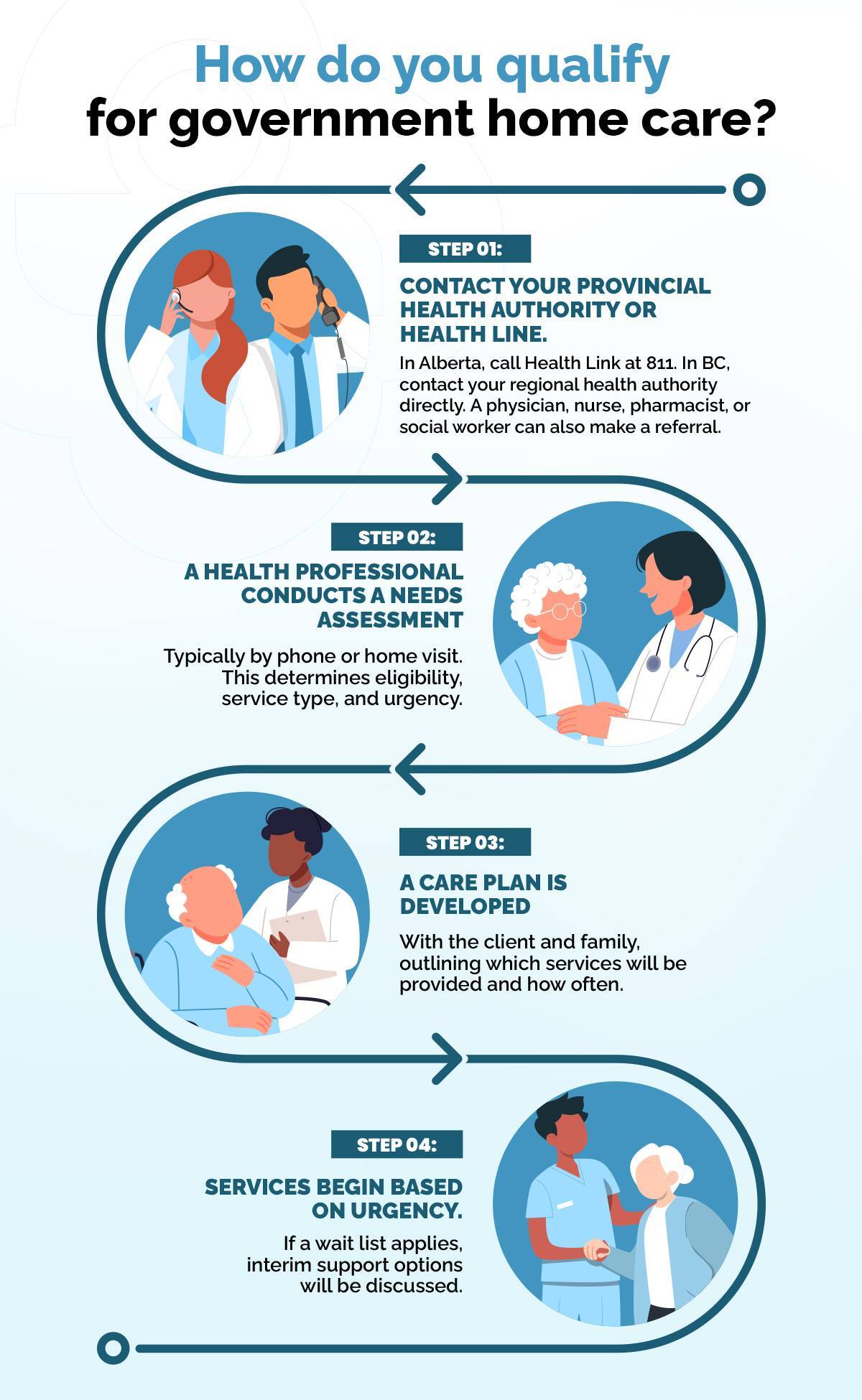
- Contact your provincial health authority or health line. In Alberta, call Health Link at 811. In BC, contact your regional health authority directly. A physician, nurse, pharmacist, or social worker can also make a referral.
- A health professional conducts a needs assessment, typically by phone or home visit. This determines eligibility, service type, and urgency.
- A care plan is developed with the client and family, outlining which services will be provided and how often.
- Services begin based on urgency. If a wait list applies, interim support options will be discussed.
Eligibility is need-based rather than income-based, though fees for some services are calculated on income. A hospital discharge is a common trigger for assessment, and families can request one before a parent leaves the hospital.
What home care does the Alberta government fund?
Alberta Health Services (AHS) delivers publicly funded home care to eligible Albertans through its continuing care system. There are two main access paths.
AHS public home care covers nursing, personal care, therapy, and palliative care for eligible residents. Services are delivered by AHS staff or contracted agencies assigned by AHS. To access this program, call Health Link at 811 to speak with an AHS health professional and request a referral.
The Client Directed Home Care Invoicing (CDHCI) program is an AHS program that allows eligible clients to choose their own approved home care provider rather than accepting the agency assigned by AHS. Under CDHCI, the chosen provider bills Alberta Blue Cross directly on the client’s behalf. This gives families more flexibility and choice while still drawing on public funding.
What home care does the BC government fund?
In British Columbia, home and community care is delivered through five regional health authorities: Fraser Health, Vancouver Coastal Health, Island Health, Interior Health, and Northern Health. To access services, contact the home and community care office of your regional health authority to self-refer or ask your physician for a referral.
Services covered include nursing, personal care, palliative care, rehabilitation referrals, caregiver respite, and medication assistance. Some services are free; others are subsidized based on after-tax income reported to the Canada Revenue Agency.
BC’s self-directed funding option is the Choice in Supports for Independent Living (CSIL) program. Similar in spirit to Alberta’s CDHCI program, CSIL gives eligible clients direct funds to hire and manage their own home support workers, providing greater control over who provides care and when. Program details and eligibility should be confirmed with your regional health authority, as rules can change.
What tax credits help with home care costs?
The federal government offers two tax mechanisms that can help offset the costs of home care. These do not pay for care upfront, but they reduce the taxes owed at filing time.
Canada Caregiver Credit (CCC): A non-refundable federal tax credit for Canadians who support a spouse, common-law partner, or dependent with a physical or mental impairment. For the 2025 tax year, eligible caregivers could claim up to $8,601 for an adult dependent.
The dependent does not need to live with you to qualify, and hiring a private home care provider does not disqualify you from claiming the CCC, as long as you continue to provide consistent support. A medical note confirming the impairment may be required unless an approved T2201 (Disability Tax Credit Certificate) is already on file. Verify current amounts with CRA before filing, as figures are indexed annually.
Medical Expense Tax Credit (METC): Out-of-pocket costs for professional home care, including personal support workers and nurses, may be claimed as eligible medical expenses. The 2025 threshold was the lesser of 3% of net income or $2,834. An approved T2201 is often required before attendant care qualifies under this credit.
Federal income programs such as Old Age Security (OAS), the Canada Pension Plan (CPP), and the Guaranteed Income Supplement (GIS) are not specifically designed to cover home care costs, but this income can help families pay for private care.
Getting Started with Government-Supported Home Care

For families who need more hours, more consistent scheduling, or services that go beyond what public programs cover, private home care can complement public funding.
Ohana Care provides in-home senior care in Calgary, Edmonton, Vancouver, and Vancouver Island. In Alberta, Ohana Care is an approved CDHCI agency, meaning eligible clients can use their AHS-funded hours through Ohana Care directly. Contact Ohana Care to learn about the options available in your area.